


 DOP
Toscana
DOP
Toscana
Saffron of San Gimignano
The Saffron of San Gimignano is a Designation of Protected Origin (DOP) on the national list approved by the Ministry of Agriculture Food and Forestry, whose requirements are regulated by the production discipline of the Tuscany Region.
Features
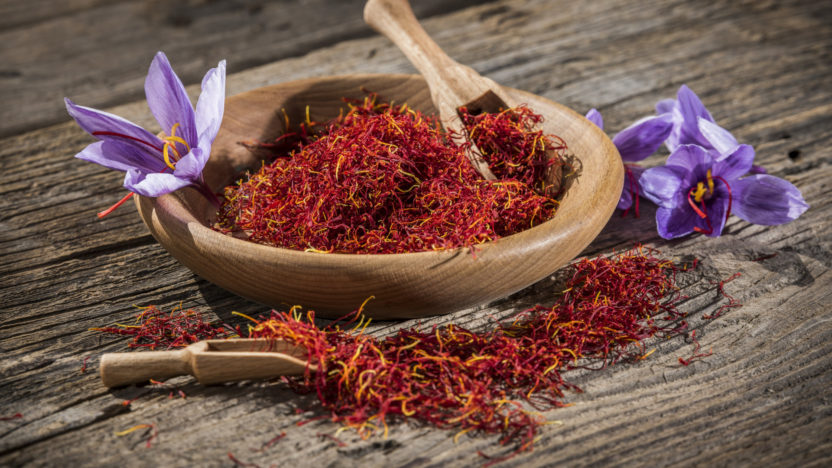
The saffron of San Gimignano consists exclusively of the orange-red part, roasted, of the stigmas of flowers from the cultivation of the bulb-tuber “crocus sativus L.”, a monocotiledone herbaceous plant belonging to the family of iridaceas.
The stigmas are presented in dilated and frayed filaments at the top.
After roasting, their color turns from orange to a characteristic burgundy red. The stigmas must be marketed intact.
Cultivation
The selection of bulbs-tubers for the implant is done with the elimination of those that have traces of rot, stains or cuts.
The plant is carried out on the sandy or sandy-limous soils that make up the weaving of the territory of San Gimignano.
It is done between the beginning of August and the middle of September.
The fertilization used is organic.
In the early morning hours flowers are collected when they are still closed.
This is done between the beginning of October and the end of November.
Production
The “flowering” or “flowering” of the collected flowers is carried out, during the same day of the harvest, in closed rooms.
This is a manual operation by which you separate the orange red part of the stigmas avoiding to take away the one of white-yellow color.
The drying is then carried out, which must always take place at a temperature of less than 50 degrees Celsius. The stigmas are arranged on lattices or in sieves, normally of stainless steel, in the vicinity of fiery embers obtained from wood (especially wood or oak), taking care to constantly turn them to ensure the uniformity of the process. Other drying systems, such as solar or electrical furnaces, are allowed.
Saffron is stored in hermetically sealed glass containers, in which the stigmas are entered within the first five minutes of the drying. These containers are kept in cool and dry rooms and sheltered from light.
History and curiosity
The subarid climate, which characterizes the production area, in particular due to water deficiency in the summer period, has a positive impact on the cultivation of the plant.
The morphological and pedological factors, consisting respectively in the hilly structure of the territory and the specific sandy and limousine weaving of the soil, which prevent stagnation of moisture, are also particularly suitable.
The undoubted vocation of the area corresponds to a link of the product with the territory based on a series of economic, social and productive factors, even of ancient tradition.
In the kitchen saffron was highly sought after, not only for its aroma but also as a dye. In the “book of the cocina” of Anonymous Tuscan of the fourteenth century it is noted that it was used in abundance. Even in the following centuries, it was the fundamental ingredient of dishes such as “the pestle”, “the peverata”, “the wing”, “the leek”. It remained the use to insert it into the dough of some cheeses.
At present, the Saffron of San Gimignano is the subject of a significant rediscovery both in terms of gastronomy and pharmacological. In the territory the uses in production as well as in processing are those consolidated by tradition according to loyal and constant methods. Many operations are still carried out by hand as in the Middle Ages: the selection of bulbs, the collection of flowers in the early morning hours, the mundane, the drying at the fire.
The product is present in the restaurant and in some local specialties, also in connection with other typical sangimignanese products, such as bread with vernaccia and saffron and crushed with saffron.